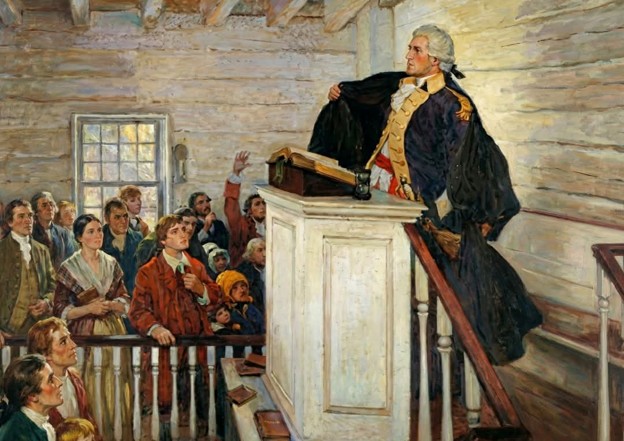


On a cold January Sunday morning in 1776, 29-year-old Reverend Peter Muhlenberg stood before his congregation in Woodstock, Virginia, and preached from Ecclesiastes 3: “To every thing there is a season…a time of war and a time of peace.” Then came a remarkable moment. At the close of his sermon, Muhlenberg removed his clerical robe, revealing the uniform of a military officer beneath. He had accepted a commission as colonel of the 8th Virginia Regiment. His congregation responded with action: nearly 300 men enlisted in his regiment.
Muhlenberg was one of many American ministers who stepped beyond the pulpit during the Revolution to serve their communities in the cause of liberty. These patriotic clergymen became known as the “Black Robe Regiment,” indicating the prominent role ministers played in encouraging resistance to tyranny. It was rumored that the term was coined by the British as a derogatory term, aimed at intimidating and delegitimizing the power and authority of the Word of God preached from the pulpit. However, the clarion call for liberty was based in Biblical principles, and their voices could not be suppressed.
Their influence reached far. When fighting broke out at Bunker Hill, Reverend David Grosvenor left his pulpit with his rifle and headed toward the battle. Reverend Jonathan French did likewise. Other ministers raised companies, commanded troops, joined as common soldiers, or rallied their neighbors to resist British forces.
The commitment of these ministers came at a cost. They were targeted because of their influence. The British abused, killed, imprisoned, and tortured clergymen, who suffered harsher treatment than other soldiers. Reverend Daggett, President of Yale, while defending private property, was arrested, stabbed multiple times with bayonets, and eventually died from the wounds. Churches, too, suffered destruction during the conflict. Nineteen church buildings in New York alone were destroyed. Reverend Caldwell (New Jersey) and his family were murdered, and their church burned.
The Black Robed Regiment largely shaped education in the colonies. Ministers understood that only a literate people, well-versed in the Bible, could sustain a free and enlightened government. They were instrumental in establishing schools and colleges that emphasized scholarship and the classics. They taught the religious principles indispensable to civil and religious liberties, vigorously preached them from the pulpit, and eventually defended them through military service, with some paying the ultimate price.
Teach the Children America’s Christian History: Family Time Talks
- What was “The Black Robe Regiment” and why is it important to learn about it?
- How did the contributions of clergy shape the American Revolution?
- Why did the American clergy think education was important?