

One of the greatest commanders in the history of the US military, John Paul Jones, achieved distinction as a naval officer through his bravery and strategic brilliance.
Early influences
Born John Paul in Scotland on July 6, 1747, he attended the Church of Scotland (Presbyterian since the Reformation) every Sabbath with his parents. He also attended the local parochial school, but most of his education was through reading and writing practice. John’s career choices were limited, and he was too poor to buy a commission in the Royal Navy, so at age 13, he packed a sea chest and signed as an apprentice on the brig Friendship.
Later, he sailed on ships involved in the slave trade but soon left because he thought it was “an abominable trade.”
Drawing his sword for liberty
John arrived in Virginia in the mid-1770s and changed his name to John Paul Jones. He fell in love with America at first sight, declaring his undying allegiance to the new nation. On many occasions, he wrote that he “drew his sword from pure love of liberty.”
In 1775, seamanship and sailing skills put John in good standing to become an officer in the newly formed American Continental Navy. As captain of Ranger, he raided ports along England’s coast, capturing the British sloop-of-war Drake (20 guns). To reward his efforts, he was given command of the Bonhomme Richard (42 guns), a gift from France named in honor of Benjamin Franklin.
“I have not yet begun to fight!”
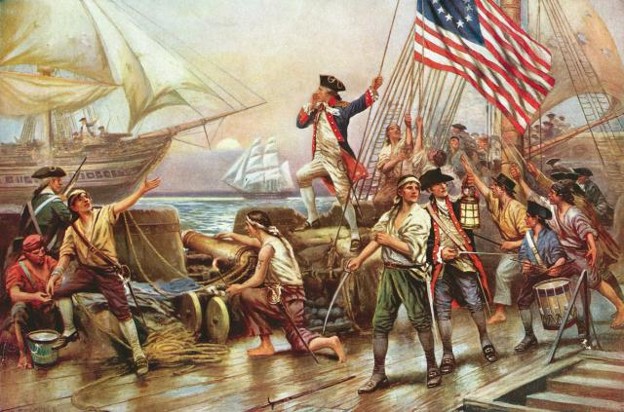
On September 23, 1779, Jones fought one of the most famous naval battles of history off the coast of Scotland. The Bonhomme Richard engaged with the Royal Navy frigate Serapis (44 guns). It was a brutal fight lasting almost four hours, with nearly half of both crews wounded and killed. Although his own vessel was burning and sinking, Jones would not accept the British demand for surrender, replying, “I have not yet begun to fight.” Serapis surrendered. It was one of the longest and bloodiest battles of the American Revolution.
Father of the American Navy
Abigail Adams met John Paul Jones in Paris after the war. She wrote to her sister, “…he is small of stature, well-proportioned, soft in his speech, easy in his address, polite in his manners, vastly civil…he is said to be a man of gallantry…”
John was an advocate for a nimble navy capable of executing raids and disrupting British supply chains on British soil. His strategic use of frigates helped defeat the world’s most formidable naval power. These two ideas won him the title of “Father of the American Navy,” the most celebrated naval hero of the American Revolution.
Teach the Children America’s Christian History: Family Time Talks
- What were the early influences on young John Paul Jones?
- What can you discern about his character from his actions and the description by Abigail Adams?
- Can you list his contributions to America and the Revolutionary War?