

Behind him lay the gray Azores,
Behind the Gates of Hercules;
Before him not the ghost of shores,
Before him only shoreless seas.
The good mate said: “Now must we pray,
For lo! The very stars are gone.
Brave Adm’r’l, speak; what shall I say?”
Why, say: ‘Sail on! Sail on! Sail on!’
Joaquin Miller
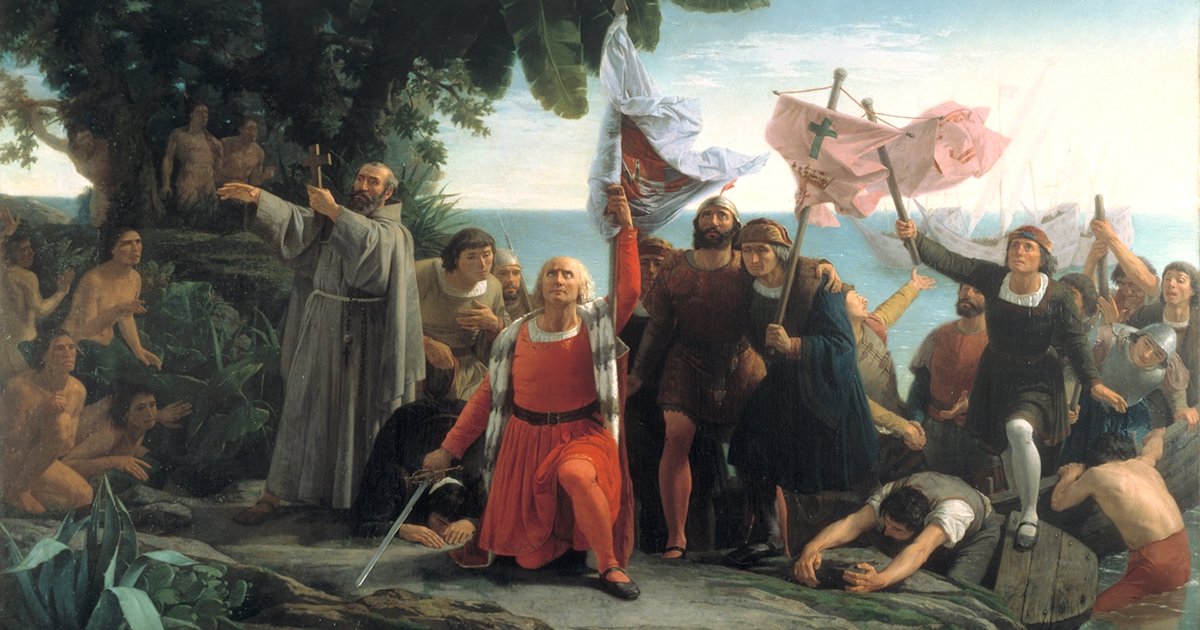
Unknown to Christopher Columbus, and to any of his investors, supporters, or crew, a new hemisphere and continent lay waiting. Mankind was ready for a fuller expression of a Christian civilization to appear.
Son of a wool merchant, Columbus spent his childhood in the port of Genoa, where stories from Genoese seamen stirred his imagination. He was a devout Christian who believed his call was God-ordained. Even his name, Christopher, which means “Christ-Bearer,” spoke to his providential mission.
Columbus set sail on August 3, 1492, from Palos de la Frontera, Spain, and arrived October 12, 1492, on an island in the New World (today the Bahamas) that he named San Salvador—Holy Savior. The arduous voyage, fraught with uncertainty and fear, was almost aborted by mutiny. But land appeared on the horizon, and a new world opened. Columbus was not the first European to reach America, but he was the one who let it be known and repeated.
Today, he stands out as one of the most consequential men who ever lived. His courage, vision, and faith changed the trajectory of human history and opened a continent for Christian self-government and a liberty unknown at the time. Columbus was a man of prayer who believed in God’s providence. His journals recorded it, and his life reflected it.
The same people who vilify Columbus and Western civilization benefit from the security, technology, and prosperity it has produced. We are living in the greatest flourishing of mankind in recorded history. We honor Christopher Columbus, who, through courage and innovation, changed the known world, the map, and the future.